PFMS is the software that sits between a Union ministry’s budget line and the ₹2,000 PM-KISAN instalment that shows up in a farmer’s bank account. Scholarship money, MGNREGA wages, grants to a district hospital and funds sent to states for centrally sponsored schemes all pass through it. Most people only notice PFMS when an SMS says money was credited “through PFMS,” or when a payment is late and someone tells them to check the portal. Behind that small screen is the Government of India’s main system for paying, recording and tracking public money.
PFMS Full Form and What the Name Means
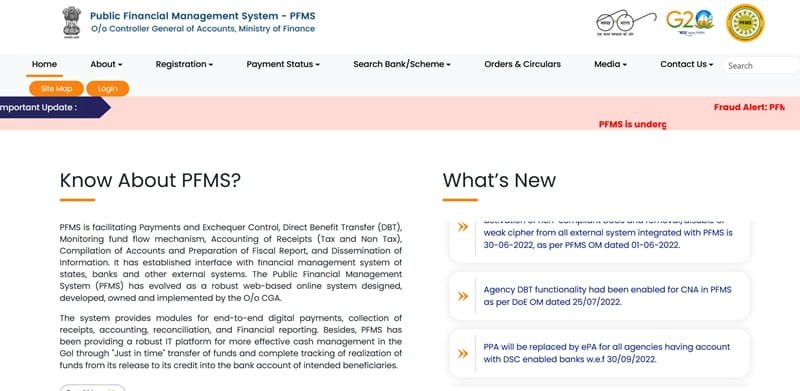
PFMS stands for Public Financial Management System.
The name is literal. “Public financial management” is the standard term for how a government plans, releases, spends and accounts for its money. “System” tells you it isn’t a scheme or a department. It’s a web-based application built and run by the Office of the Controller General of Accounts, the government’s top accounting authority.
Its old name, CPSMS, gives away what it was first built for: monitoring Plan schemes. It now does much more than monitor.
A simple way to think about it: the Union Budget decides how much goes where, and PFMS records where it actually went, right down to the last bank account that received it.
How a Rupee Travels Through PFMS
Take a central scholarship scheme. Simplified, the money moves like this:
- The ministry sanctions funds for the scheme on PFMS.
- Funds go to a registered implementing agency, or, under newer rules, stay with the treasury until they’re needed.
- The agency uploads the beneficiary list with bank details.
- PFMS sends those accounts to the banks for validation. Closed accounts, wrong IFSC codes and name mismatches get caught here.
- Validated beneficiaries are paid electronically, and the result flows back into PFMS.
Every step leaves a record. An official in Delhi can see how much a scheme has released, how much is lying unspent with an agency and how many payments failed last week, without waiting for paper utilisation certificates.
That visibility comes from integration. PFMS talks to the core banking systems of banks, to state treasuries, to NPCI for Aadhaar-based payments and to the RBI’s e-Kuber platform.
From a Four-State Pilot to a National Payment Platform
PFMS started small. The pilot ran in 2008-09 in four states, and the system formally began in 2009 to track funds under Plan schemes and report spending at every level.
The big change came in 2013, when its scope expanded to direct payments to beneficiaries under both Plan and non-Plan schemes. That’s when PFMS became the backbone of Direct Benefit Transfer. From late 2014, the government began digitising its accounts through PFMS, folding older standalone systems into it over time.
The latest shift is about timing. Under the SNA-SPARSH model, rolled out in 2023-24, money for centrally sponsored schemes is released closer to the moment it’s spent instead of sitting in bank accounts for months.
PFMS Portal Features
The portal serves two audiences. Citizens use a few public tools. Ministries, agencies and treasuries use the rest after logging in.
Know Your Payments
This is what most visitors come for. Select your bank, enter your account number, fill the captcha, and the portal lists government payments credited to that account through PFMS. You may also need an OTP sent to the mobile number registered with your bank.
DBT Status Tracker
Here you can search by application ID, beneficiary code or account number to see both bank validation and payment status. Something many people miss: results go back two years for National Scholarship Portal payments but only about six months for other schemes. An older payment may not appear even though it was made.
Track NSP Payments
Students who applied on scholarships.gov.in can follow their scholarship here once the institute and state have verified the application.
DBT Module
Agencies use this for beneficiary registration, account validation and bulk payment files. Payments can go to bank or post office accounts.
EAT Module
Short for Expenditure, Advance and Transfer, this module records what an agency spends, the advances it gives and the money it passes on to lower-level agencies. Because entries are tied to real bank transactions, spending figures reaching a ministry reflect actual payments.
SNA, CNA, TSA and SNA-SPARSH
The acronyms look heavy, but the ideas are simple:
- SNA (Single Nodal Agency) means each state runs a centrally sponsored scheme through one nodal agency and one bank account, not dozens.
- CNA (Central Nodal Agency) applies the same idea to central sector schemes.
- Under TSA (Treasury Single Account), autonomous bodies keep funds in the government’s account until the day they actually pay.
- SNA-SPARSH links PFMS, the state’s financial management system and the RBI’s e-Kuber so funds move only when a payment is due.
The logic is basic arithmetic. Money parked idle with an agency for six months may be money the government borrowed and is paying interest on. Releasing it just in time trims that cost.
Agency Registration and Live Bank Balances
Any body receiving government funds, from a central university to a village-level committee, registers on PFMS with its bank account linked. Ministries can check an agency’s unspent balance before approving the next grant.
Who Logs In, and Who Doesn’t Need To
| User | What they use PFMS for | Login needed? |
| Farmers, students, pensioners, workers | Checking whether a DBT payment arrived | No |
| Implementing agencies | Receiving funds, filing expenditure, paying beneficiaries | Yes |
| Ministry programme divisions | Sanctioning and releasing funds, monitoring schemes | Yes |
| Pay & Accounts Offices and DDOs | Passing bills, making payments, keeping accounts | Yes |
| State treasuries | Exchanging data for central and state shares | System integration |
| Banks | Validating accounts, processing payment files | System integration |
If a website asks you to “create a PFMS login” just to see your payment, close it. The citizen tools don’t need one.
Reading Your Payment Status Without Panic
PFMS statuses show where a payment sits in the pipeline. They don’t decide eligibility. Before you worry:
- “Sent to bank” or “pending at bank” means the file has left PFMS. Give it a few working days.
- “Success” means your bank confirmed the credit. If you can’t spot it, look for a scheme or DBT entry in your statement; the narration may not mention PFMS.
- Failed payments usually carry a reason, such as a closed or frozen account, name mismatch, invalid IFSC or Aadhaar not seeded.
- Aadhaar-based payments go to whichever account is currently mapped to your Aadhaar in the NPCI mapper. With accounts in two banks, the money might land in the one you didn’t expect.
- If the scheme hasn’t approved you, nothing will appear on PFMS at all.
Fixes nearly always happen at your bank (KYC, Aadhaar seeding, reactivation) or with the scheme office, after which the agency re-sends the payment.
PFMS, DBT Bharat and Bharatkosh Are Not the Same
These three get mixed up all the time.
PFMS handles money going out of government to agencies, vendors and beneficiaries. DBT Bharat (dbtbharat.gov.in) is the DBT Mission’s reporting portal for schemes using Direct Benefit Transfer, though the transactions themselves run on PFMS. Bharatkosh, also run by the CGA, handles money coming in, such as non-tax fees and dues paid to the government.
Paying a government fee? Use Bharatkosh. Waiting to receive money? Check PFMS.
When You Call the PFMS Helpdesk
Keep your bank name, account number, scheme name and application ID or beneficiary code ready before dialling 1800-118-111. The helpdesk can tell you what PFMS shows about a payment. Approvals stuck with a state department or scheme office have to be followed up there.
FAQs
Q. What is the full form of PFMS?
PFMS stands for Public Financial Management System, run by the Controller General of Accounts under the Ministry of Finance.
Q. What was PFMS called earlier?
It was earlier known as CPSMS, the Central Plan Scheme Monitoring System.
Q. What is the official PFMS website?
The official portal is pfms.nic.in.
Q. Do I need a login to check my PFMS payment status?
No. Beneficiaries can use Know Your Payments or the DBT Status Tracker with their bank details, no login required.
Q. Which schemes pay through PFMS?
Most central DBT payments, including PM-KISAN, NSP scholarships and MGNREGA wages, are processed through PFMS.
Q. Why does my PFMS payment show as failed?
Usually because of an inactive or closed account, a name mismatch, a wrong IFSC code or Aadhaar not seeded with the account.
Q. What is SNA-SPARSH in PFMS?
It’s a just-in-time fund release system for centrally sponsored schemes linking PFMS, state treasury systems and RBI’s e-Kuber.
Q. What is the PFMS helpline number?
The toll-free PFMS helpline is 1800-118-111, and the email is helpdesk-pfms@gov.in.
3 thoughts on “What is PFMS? PFMS Full Form, Meaning, PFMS Portal Features”